
Automated Inspection Challenge
Automated Final Inspection in Cylinder Head Manufacturing
Got what it takes to build the future of quality control?
Applications are now closed.
Problem Statement and Context
At Volkswagen’s engine plant in Chemnitz, hundreds of thousands of cylinder heads are manually inspected each year. boOst and Volkswagen Group Innovation are looking for an automated solution that can reliably perform this complex 360-degree final inspection and relieve skilled employees for other tasks.
Current process
Manual 360-degree inspection of surfaces, drill holes, threads, contours, and contamination.
Why it matters
The task ties up experienced employees while skilled labor is becoming increasingly scarce.
What we are looking for
An automated inspection solution that reliably meets quality requirements.
The Technical Challenge
Automating this inspection is challenging because cylinder heads combine complex geometries, reflective metal surfaces, and dozens of zone-specific quality criteria. Any solution must detect real defects reliably while avoiding excessive false positives.
360-degree inspection of surfaces, drill holes, threads, contours, and contamination.
Reflective metal surfaces and many simultaneous inspection features push conventional camera systems to their limits.
Inspectors assess context, borderline cases, and distinguish relevant defects from harmless deviations.
Why now?
AI, deep learning, advanced imaging, and robotic handling are making economically viable automation realistic for the first time.
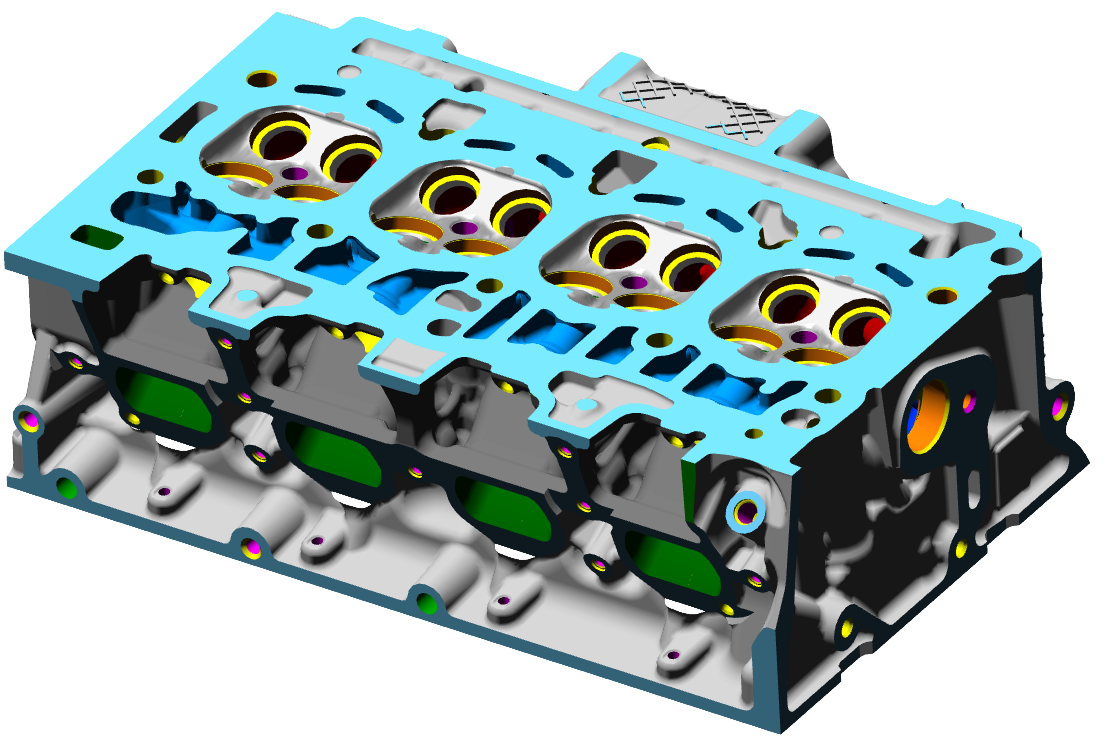
This is an illustration of the R4 EU7 cylinder head. The following are part of the inspection task:
- 157 drill holes, up to 186 mm deep and 7 mm in diameter, to be inspected
- 24 surfaces to be inspected
- Component dimensions: approx. 375 x 247 x 115 mm
Why now?
Scope
The solution must automatically cover the full scope of inspection as specified in the inspection procedure: defects, holes, threads, contours, and contamination. This applies to all six sides of the component.
Integration
All suitable inspection technologies (optical/ non-optical) as well as hybrid systems are permitted. The solution can be flexibly integrated into the production line or the final inspection station but must take spatial constraints into account.
Validation
Volkswagen provides component samples that are to be used to detect specific failure patterns based on standardized metrics. The goal is to create a real-world test setup. Digital test environments using synthetic data may additionally be used.
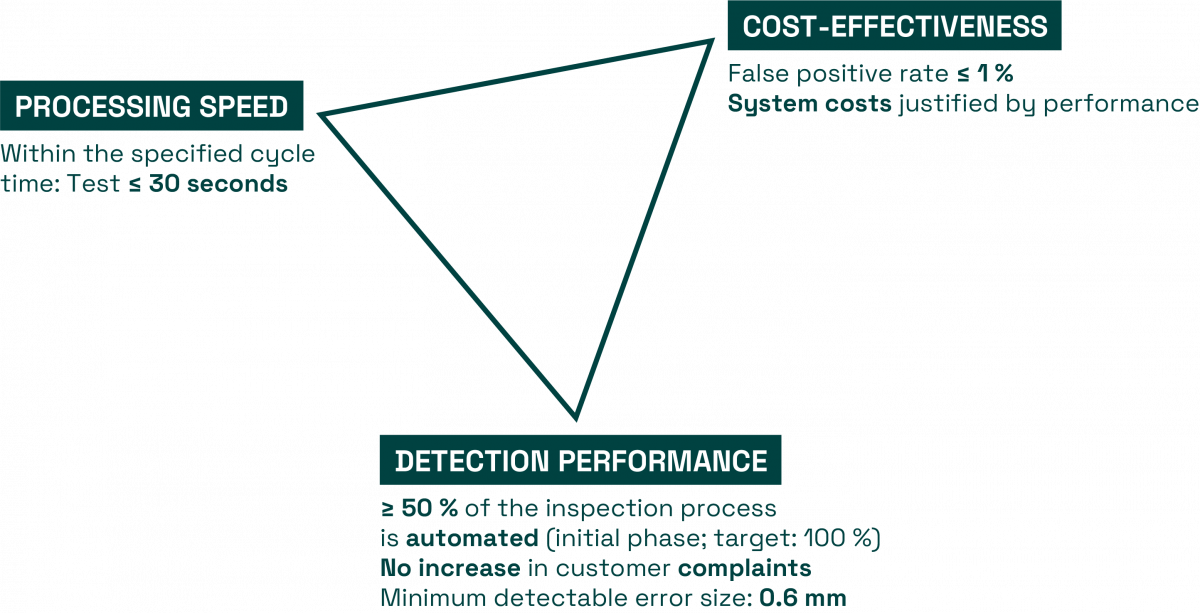
The quality of a solution is measured by how effectively it balances the competing priorities of detection performance, processing speed, and cost-effectiveness.
The most successful team will have the opportunity to implement its solution in one of Volkswagen’s production facilities, provided it receives a favorable evaluation. Scaling the solution to additional production lines is possible.
Applications are now closed.
The challenge “Automated Final Inspection in Cylinder Head Manufacturing” is a structured innovation competition in which 3–5 European startups work in parallel on the same challenge and pit their solutions against one another.
boOst organizes and moderates the challenge, provides methodological support to the teams, and coordinates all points of contact between the startups and Volkswagen Group Innovation. Volkswagen Group Innovation provides structured feedback at set milestones, evaluates the results, and decides on the next steps for each team.
Application Process
A team may consist of a single organization or a consortium. This call for proposals is open to startups and companies from across Europe. Teams apply via registration form. We may contact you if we have any further questions or would like to conduct an interview with you.
Applications are now closed.
The following must be submitted
- Pitch Deck (PDF, max. 15 slides)
- Technical Approach & Suitability (PDF, max. 5 pages) including
- understanding of the problem
- proposed technology/components (software/hardware) and their relevance to the challenge
- development and testing strategy
- team introduction, including skills relevant to the challenge
- Optional: Demo video/introduction video (max. 3 min), images/screenshots, datasheets for relevant components, additional documents
Timeline
June 25, 2026
Application deadline
July 02, 2026
Team selection & onboarding
July 06, 2026
Kickoff with all teams in Chemnitz
July, 2026
Phase I: Problem analysis & solution concepts Progress report I
July – August, 2026
Phase II: Solution development and prototype Progress report II
August – September, 2026
Phases III & IV: Testing, development, and pilot planning with reviews
Late September, 2026
Demo Day and jury evaluation
More Information
If you have any further questions, please contact: