
Automated Inspection Challenge

Automated Final Inspection in Cylinder Head Manufacturing
APPLICATIONS DUE BY JUNE 25, 2026
Problem Statement and Context
At the Volkswagen engine plant in Chemnitz, hundreds of thousands of cylinder heads undergo a manual 360-degree final inspection each year. Experienced employees inspect surfaces, drill holes, threads, contours, and contamination in accordance with detailed inspection guidelines. While this inspection ensures quality targets are met, it ties up qualified personnel who are needed elsewhere in the plant. Demographic shifts and a shortage of skilled workers are intensifying this pressure. boOst & Volkswagen Group Innovation are therefore seeking an automated solution that can reliably take over this inspection task.
The Technical Challenge
The cylinder head is a complex, intricate cast part with numerous hard-to-reach surfaces, small threads, drill holes, and zone-specific tolerances. The metal surface reflects light in varying ways, and at the same time, dozens of different features must be evaluated simultaneously. Conventional camera systems reach their limits in this scenario and, in practice, generate too many false positives.
Furthermore, human inspectors can judge based on context, react adaptively to borderline cases, and reliably distinguish between relevant defects and harmless deviations. This combination of experience, judgment, and flexibility has historically been the hurdle for automation approaches and sets the bar for any new solution.
AI and deep learning, modern imaging techniques, and automated robotic handling now make it possible to fully capture complex components and precisely detect defect patterns. This makes economically viable automation realistic for the first time.
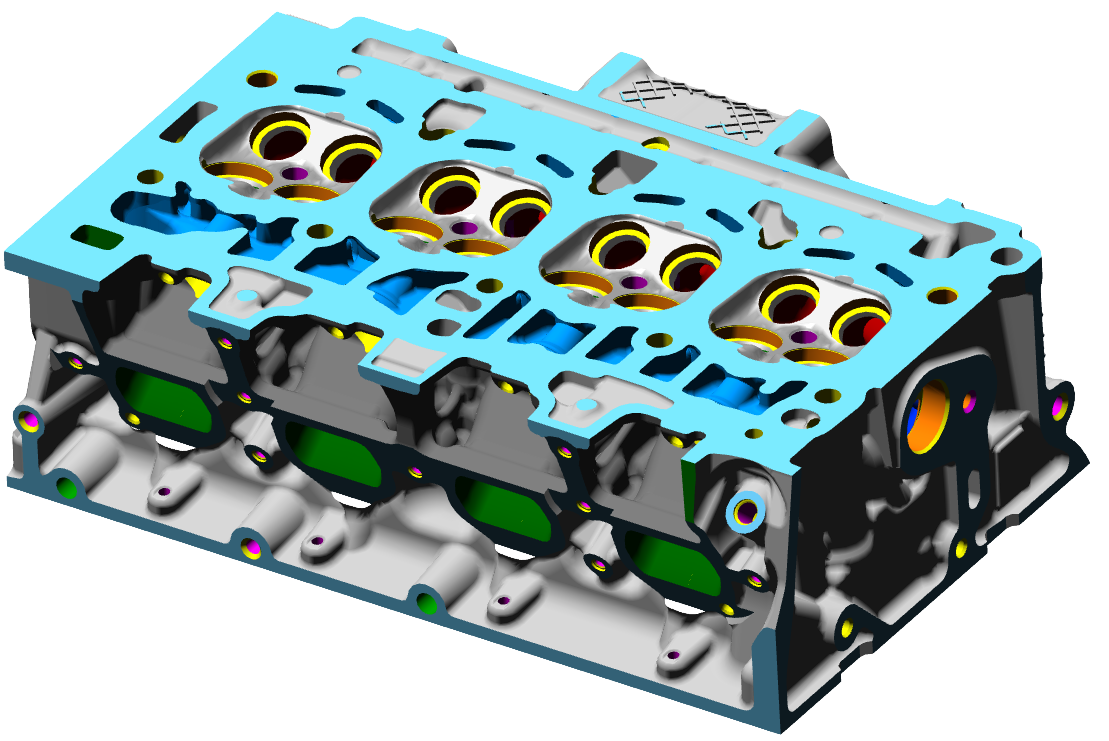
This is an illustration of the R4 EU7 cylinder head. The following are part of the inspection task:
- 157 drill holes, up to 186 mm deep and 7 mm in diameter, to be inspected
- 24 surfaces to be inspected
- Component dimensions: approx. 375 x 247 x 115 mm
Solution Requirements
SCOPE
The solution must automatically cover the full scope of inspection as specified in the inspection procedure: defects, holes, threads, contours, and contamination. This applies to all six sides of the component.
INTEGRATION
All suitable inspection technologies (optical/ non-optical) as well as hybrid systems are permitted. The solution can be flexibly integrated into the production line or the final inspection station but must take spatial constraints into account.
VALIDATION
Volkswagen provides component samples that are to be used to detect specific failure patterns based on standardized metrics. The goal is to create a real-world test setup. Digital test environments using synthetic data may additionally be used.
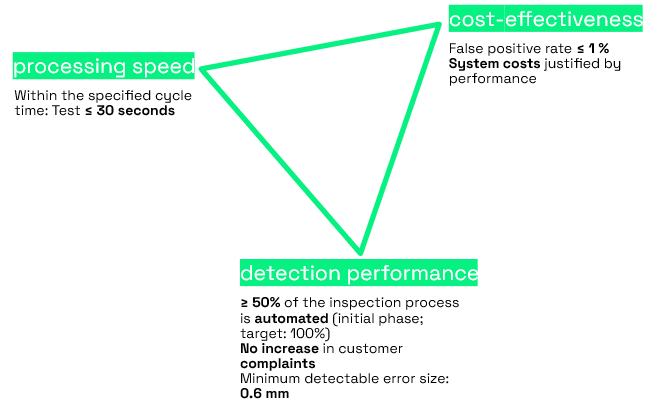
The quality of a solution is measured by how effectively it balances the competing priorities of detection performance, processing speed, and cost-effectiveness.
The most successful team will have the opportunity to implement its solution in one of Volkswagen’s production facilities, provided it receives a favorable evaluation. Scaling the solution to additional production lines is possible.
The challenge “Automated Final Inspection in Cylinder Head Manufacturing” is a structured innovation competition in which 3–5 European startups work in parallel on the same challenge and pit their solutions against one another.
boOst organizes and moderates the challenge, provides methodological support to the teams, and coordinates all points of contact between the startups and Volkswagen Group Innovation. Volkswagen Group Innovation provides structured feedback at set milestones, evaluates the results, and decides on the next steps for each team.
You can find more information about the format [here].
Application Process
A team may consist of a single organization or a consortium. This call for proposals is open to startups and companies from across Europe. Teams apply via registration form. We may contact you if we have any further questions or would like to conduct an interview with you.
The following must be submitted:
- Pitch Deck (PDF, max. 15 slides)
- Technical Approach & Suitability (PDF, max. 5 pages) including
- understanding of the problem
- proposed technology/components (software/hardware) and their relevance to the challenge
- development and testing strategy
- team introduction, including skills relevant to the challenge
- Optional: Demo video/introduction video (max. 3 min), images/screenshots, datasheets for relevant components, additional documents
Timeline
June 25, 2026
Application deadline
July 02, 2026
Team selection & onboarding
July 06, 2026
Kickoff with all teams in Chemnitz
July 2026
Phase I: Problem analysis & solution concepts
Progress report I
July – August 2026
Phase II: Solution development and prototype
Progress report II
August – September 2026
Phases III & IV: Testing, development, and pilot planning with reviews
Late September 2026
Demo Day and jury evaluation
More Information

If you have any further questions, please contact:
Luise Matthes
Program manager industry programms
Let's build tech startups
Join the movement and see what startup culture can do to change the world.